
Selling a business: plan the tax before the letter of intent
The price in the offer is not what you keep. How the deal is structured, and when you plan for it, decides how much of the sale goes to taxes.
Why is most of the tax decided before you sign?
By the time a buyer sends a letter of intent, the biggest choices are usually made. The kind of entity you own, whether you sell assets or stock, how the price is split, and when the money arrives all change your tax. After you sign, very little is left to change.
Think of the letter of intent as the moment the structure sets, like concrete. You can still negotiate price. You can rarely change the shape. If a letter just arrived, what to know before you sign a letter of intent walks through it clause by clause.
Should you sell assets or stock?
In a stock sale, you sell the company itself and most of the gain is usually capital gain. In an asset sale, the buyer buys the assets and the price is split among them, each part taxed its own way. The same price can leave you with very different amounts.
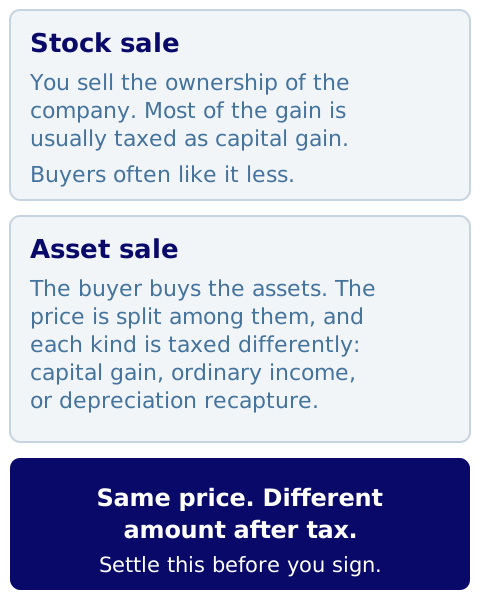
Buyers often prefer assets, because the price becomes new depreciation for them (IRC section 1060). Which structure makes sense depends on whether you own a C corporation, an S corporation, a partnership or an LLC. It is one of the first things to settle, and a negotiation point worth real money.
How does the price allocation change your tax?
In an asset sale, buyer and seller each report how the price was divided among the assets on IRS Form 8594. The form sorts assets into seven classes, from cash to goodwill. What matters to you is how each kind is taxed.
| What you are selling | Usual tax result | Where to read |
|---|---|---|
| Goodwill and similar assets | Generally capital gain | IRS Topic 409 |
| Equipment and other depreciated assets | Depreciation recapture, taxed as ordinary income | IRC section 1245 |
| Inventory and receivables | Generally ordinary income | IRS Publication 544 |
| Buildings and land | Capital gain, with the depreciation part taxed up to 25 percent | IRS Topic 409, IRS Publication 544 |
Who files Form 8594 and how the seven classes fill walks through the form itself, including what happens when you and the buyer disagree on the split.
Your state may tax the sale too. Some high earners also owe the net investment income tax, a 3.8 percent tax on investment income above a threshold.
How can you spread out or defer the tax?
These are options to look at, not recommendations. Which ones fit depends on the facts, and each has rules and risks.
| Option | What it does | Worth knowing |
|---|---|---|
| Installment sale | You are paid over time and report the gain as you receive payments | Interest is taxed separately. Inventory does not qualify, and depreciation recapture is taxed in the year of the sale even if you are paid later (IRC section 453, IRS Publication 537). |
| 1031 exchange | Defers tax on real estate in the sale | If the business owns real estate, or you own the building, a 1031 exchange can defer that part. It applies to real property only. If it does not fit, a lazy 1031 is another route with its own risks. |
| Qualified small business stock | Some owners of certain C corporations can exclude part of the gain | The rules are narrow and changed recently. Check them before you count on it (IRC section 1202). |
| Structures sold by promoters | Marketed heavily | We look at them with the same skepticism we bring to any strategy. Ask who the independent trustee is, whether anyone has defended the structure, and what happens if the IRS disagrees. |
When should you start planning?
The best time is years before a sale, when you can still change the entity, clean up the books and time income. The last good time is before you sign the letter of intent. After that, you are mostly negotiating around a structure that is already set.
What does Anvil do when you sell a business?
Anvil is not a CPA firm and not a law firm. Daveed Tuck is a former IRS auditor and an Enrolled Agent, and our work is to find out where the tax will land before it does.
- We read your returns and your books the way the IRS reads them.
- We model the deal structures that are realistic for your situation.
- We work alongside your CPA and your attorney, not instead of them, so the plan fits the deal they are already negotiating.
Wondering which professional you need? See CPA or enrolled agent.
What should you ask your advisors?
- Is the sale an asset sale or a stock sale, and why?
- How will the price be allocated, and what does each category cost me in tax?
- What is my depreciation recapture, and how much of the gain is ordinary income?
- Could an installment sale or other deferral fit, and what are the risks?
- Which state taxes apply, and does where I live or sell change them? See Oregon tax on the sale of a business and Washington tax on the sale of a business.
- What happens to my tax if the buyer pays part of the price later, or the deal changes?
Does selling a business trigger an IRS audit?
Not by itself. The sale year return is read against the deal papers, and the buyer files the same deal from the other side. See does selling a business trigger an IRS audit for what gets looked at and how to clean up first.
Where can you check these rules yourself?
- Asset sales and price allocation: IRC section 1060 and the Form 8594 instructions.
- Recapture and capital gain rates: IRC section 1245, IRS Topic 409 and IRS Publication 544.
- Installment sales: IRC section 453 and IRS Publication 537.
- Qualified small business stock: IRC section 1202.
- Net investment income tax: IRS guidance.
- Real estate in the sale: 1031 exchange rules.
This page is general information, not tax, legal or investment advice for your situation. Reading it does not create a client relationship. Tax law changes often, so check the current rules with a qualified professional before you act. See our disclaimer.