
Does Oregon tax the sale of my business?
Yes, and without the break the federal return gives long-term gains. A Portland resident can lose close to 14 cents of every dollar of gain to state and local tax before the federal bill.
Does Oregon tax the sale of my business?
In Multnomah County or inside the Metro boundary, two local income taxes reach the same gain.
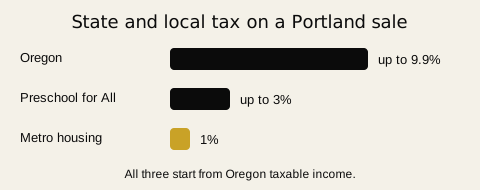
The federal 20 percent long-term rate that owners plan around does not exist on the Oregon return. On a gain of 2,000,000 dollars, nearly all of it is taxed at the full 9.9 percent.
Does living in Portland add county and Metro tax?
It does, and both start from Oregon taxable income, so the gain flows straight in.
| Tax | Rate | Starts above (2026) |
|---|---|---|
| Oregon personal income tax | Up to 9.9 percent | 125,000 dollars single, 250,000 dollars joint |
| Multnomah County Preschool for All | 1.5 percent, then three percent | 125,000 and 250,000 dollars single, 200,000 and 400,000 dollars joint |
| Metro supportive housing services | One percent | 128,000 dollars single, 205,000 dollars joint |
The county board delayed a scheduled 0.8 point Preschool for All increase from January 1, 2027 to January 1, 2028 (Multnomah County). The Metro thresholds are indexed each year (Portland Revenue Division).
Does the Oregon CAT hit the sale price?
Mostly no. The Corporate Activity Tax is 250 dollars plus 0.57 percent of taxable Oregon commercial activity over 1,000,000 dollars, and registration starts at 750,000 dollars (Oregon Department of Revenue, CAT).
Receipts from assets described in section 1221 or 1231 are excluded, however long you held them (ORS 317A.100).
Goodwill, equipment and real estate generally come out. Inventory and receivables are generally in, because they are not 1221 or 1231 assets, so the inventory number in your allocation matters. The 35 percent subtraction for cost inputs or labor may reduce what is taxed. Confirm your facts with the Department of Revenue's CAT team.
What is the PTE-E election, and why does it matter in a sale year?
The pass-through entity elective tax lets an S corporation or partnership pay Oregon tax at the entity level, with the owners taking a credit. The rate is nine percent on the first 250,000 dollars of distributive proceeds and 9.9 percent above (Oregon Department of Revenue, PTE-E).
Tax the entity pays reduces the federal income passed through to you.
State tax you pay personally runs into the federal cap on state and local tax deductions, which a sale year blows past. The election is made each year by filing Form OR-21 by the due date, including extensions, and a late return is not accepted. Under SB 1510 (2026) it runs for tax years beginning before January 1, 2028, and it ends sooner if the federal cap ends.
Asset sale or stock sale: which one can use the PTE-E?
This is the fork. When the entity sells its assets, the gain lands on the entity, and the Department of Revenue counts net capital gain and net section 1231 gain as distributive proceeds. The election reaches it.
When you sell your own stock or membership interest, the gain is yours, not the entity's, and nothing in the Department's guidance pulls it into distributive proceeds. Confirm unusual facts with the Department. An asset sale has its own cost in depreciation recapture, so weigh both before you choose.
I live in Washington and my business is in Oregon. Does Oregon still tax me?
Yes, on the Oregon-source part. Income from intangible property is Oregon-source only to the extent the property was employed in an Oregon business (ORS 316.127). For an S corporation shareholder, the corporation's Oregon-source income is Oregon-source to you regardless.
Crossing the bridge to Vancouver does not take the Oregon shop out of Oregon. A Washington resident may also owe Washington's capital gains tax, seven percent on long-term gains above its standard deduction and 9.9 percent above 1,000,000 dollars, so model both states on the same closing statement.
What does this look like in a real deal?
Picture Frank, a composite with details changed: a custom home builder in Clackamas County, organized as an S corporation, with an offer of 3,100,000 dollars. Frank lives outside the Metro boundary and outside Multnomah County, so neither local tax applies. The year-end plan was to report whatever closed.
Two things sat in plain sight. The deal was drafted as a stock sale, so the PTE-E would not touch the gain. The company also carried about 400,000 dollars of materials inventory the buyer wanted included, which counts as commercial activity for the CAT.
Restructuring to an asset sale with the inventory handled separately, and electing the PTE-E with the first estimates paid on time, changed the federal picture. It also changed the recapture, which had to be weighed. This could have been avoided. It only required looking at the deal 18 months early.
What should I do before I sign?
- Confirm where you live for tax purposes, and whether that address is inside Multnomah County or the Metro boundary.
- Decide with the buyer whether this is an asset sale or an interest sale, and know what that does to the PTE-E.
- If the entity will elect, register on Revenue Online and pay estimates on schedule. For 2026, the first two installments are both due June 15.
- Pull the inventory figure out of the allocation and check it against the CAT thresholds.
- If you live in Washington, model both states on the same closing statement.
Selling a business covers structure and timing, and Selling something big shows every tax layer on a sale.
What is the next step?
Would it be a bad idea to see the Oregon bill before you agree to the structure? Take the Stop the Tax Leaks Scorecard. If an offer is real, book a Right Fit Call, and bring the term sheet.
Anvil is not a CPA firm and not a law firm. This is general information, not tax advice. Talk to a qualified professional about your situation.
Where can you check these rules yourself?
- Oregon Department of Revenue, tax rate charts
- Oregon Department of Revenue, Corporate Activity Tax
- ORS 317A.100, commercial activity exclusions
- Oregon Department of Revenue, pass-through entity elective tax
- ORS 316.127, Oregon-source income of nonresidents
- Multnomah County Preschool for All tax
- City of Portland Revenue Division, personal taxes
The stories on this page are composites. They are inspired by real situations, but names, facts and details have been changed.
This page is general information, not tax, legal or investment advice for your situation. Reading it does not create a client relationship. Tax law changes often, so check the current rules with a qualified professional before you act. See our disclaimer.