
Lazy 1031 exchange: how it works and when it backfires
You sell a rental, buy another, and let depreciation on the new one cancel out the gain. It can work. It can also fall apart.

What is a lazy 1031 exchange?
A lazy 1031 is a nickname, not a tax term. You sell a rental at a gain, skip the formal exchange, buy another rental, and use depreciation on the new building to cancel out the gain. There is no middleman and there are no countdown clocks.
The real thing comes from section 1031 of the tax code, and the IRS explains it in its like-kind exchange tips. The lazy version borrows the idea and none of the rules. That makes it easier. It also makes it easier to get wrong.
How does a lazy 1031 work?
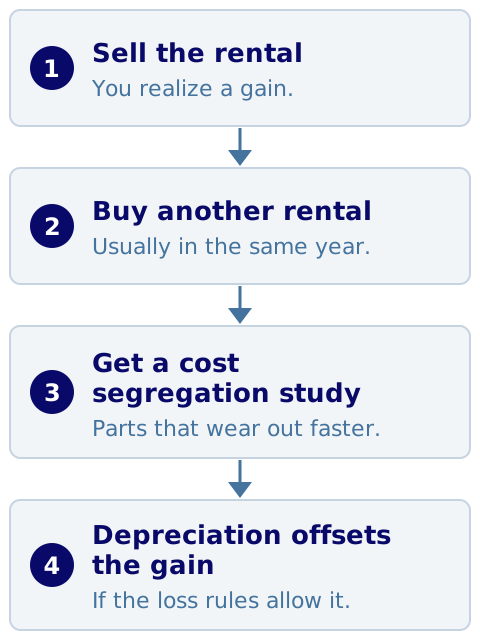
Step three does the heavy lifting.
A cost segregation study is an engineer's report that sorts what you paid for into two piles. The building itself gets written off slowly, over decades. The quick-wearing parts, like flooring, appliances, paving and landscaping, get written off much faster. The IRS even publishes how its examiners review these studies.
For those quick-wearing parts, bonus depreciation can let you write off most or all of the cost in year one (IRC section 168(k)).
Then the offset. The gain from selling a rental is usually passive income, and a loss from another rental is passive too, so one can cancel the other (IRS Publication 925). You do not have to be a full-time real estate professional for that.
Lazy 1031 or a real 1031 exchange?
| Real 1031 exchange | Lazy 1031 | |
|---|---|---|
| Deadlines | 45 days to name a replacement, 180 days to close | None |
| Middleman | Required, to hold your money | Not needed |
| What you can buy | Like-kind real property | Any property that makes enough depreciation |
| What happens to the tax | Put off | Offset by deductions you may have to pay back later |
| How it fails | You miss a rule or a date | The numbers or the paperwork do not hold up |
A real exchange is a race against two clocks. The lazy version trades the race for homework.
Why do investors like a lazy 1031?
- No clocks, no middleman fee.
- Wider choice. The new property does not have to be like-kind.
- You are not forced to put every dollar of the sale into the next deal.
Where does a lazy 1031 go wrong?
Almost always in the same few places. Here they are in plain English, with where to read the rule yourself.
| The trap | In plain English | Read the rule |
|---|---|---|
| Depreciation delays tax | Faster write-offs lower what the building is worth on paper. When you sell it, some of the tax comes back. That is called recapture. | IRS Publication 544 |
| The loss has to be usable | Rental losses mostly cancel rental gains. If the new property does not make enough loss, the gain stays taxable. | IRC section 469 |
| You can only deduct your stake | In a partnership or syndication, you deduct its losses only up to what you have in it. The rest waits. | IRC section 704(d), section 465 |
| The bonus rate depends on the year | The share you can write off in year one has changed a lot. See the chart below. | IRS Notice 2026-11 |
| Big losses hit a yearly cap | A very large first-year loss can run into a limit on how much business loss you can use in one year. | IRC section 461(l) |
| A thin study invites questions | The IRS tells its examiners what a good study looks like. A shortcut study fails that test. | IRS Publication 5653 |
State rules can differ from the federal ones, so check yours too.
What does a lazy 1031 look like when it goes wrong?
Fred and Jane are composites. They are inspired by real situations, and names, facts and details have been changed.
Fred is 71, a retired engineer in Boise, married to Elaine. He loves numbers. His line, every time we talk, is "Show me the numbers."
He sold a rental. The sale closed, the money landed in his account, and then he called me. "Can I still do a 1031?"
That question is heartbreak.
A formal exchange has to be set up before closing, with a middleman holding the money so you never touch it (Treasury Regulation 1.1031(k)-1). Once the cash is in your own account, that door is shut. I told him what I tell everyone: the best time to plan is before you list.
There was a second door, though. Fred had a gain of 300,000 dollars. If he bought into another property this year and let depreciation soak it up, he could still make a lazy 1031 work.
He found a syndication, which is a group deal where investors pool money to buy an apartment complex. He put in 200,000 dollars.
The deal ran a cost segregation study, and his first-year tax form for it, a K-1, showed a 250,000 dollar loss. Fred did his math. Two-fifty against three hundred. Close enough.
It was not close enough. A partner can deduct a partnership's loss only up to their stake in it (IRC section 704(d)), and Fred's stake was 200,000 dollars. Fifty thousand dollars of the loss had to wait.
He owed tax on that slice of the gain right away. The loss was not gone, since it carries forward. He still paid for the wait.
Fred had the right numbers for the deal and the wrong numbers for himself. This could have been avoided.
What would an IRS examiner check first?
I spent years on the other side of that desk, so here is the short list.
- Does the loss fit inside your stake? Fred's did not.
- Do the gain and the loss match under the passive rules? Rental against rental is fine. Rental against your paycheck is a different test.
- Is the paperwork there? The closing statements, the study, and the partnership's basis records.
What does a lazy 1031 look like when it goes right?
Jane is 47 and runs a small service business in Nashville with her husband Chris. They have two teenagers and a rescue dog named Mocha. Jane does not want tax tricks. She wants the rules followed, and she wants to sleep at night.
Last year Jane bought a building and waited on a cost segregation study. By late December she was asking me, "Did I miss it?" This time she did not wait.
She called me before she listed her rental. Selling, I told her, is not a moment. It is a sequence.
So we ran the sequence. We projected the tax first. Then we compared a real exchange with a lazy one, and she picked lazy because she wanted freedom on what to buy.
She found the building before she sold. The day she closed on it, she booked the engineering study. Everything went into one folder: both closing statements, the study, and an independent split between land and building, since land cannot be depreciated.
When the numbers came back, Jane asked the question she always asks. "Does this count?" We went through it line by line. A qualified engineer did the study, the land was split out, and the loss matched the gain under the passive rules. Yes, it counted.
Here is how her numbers looked. They are illustrative, and the real share comes only from the engineer's study.
| Step | Jane's example |
|---|---|
| Gain on the rental she sold | 300,000 dollars |
| Price of the new building | 1,600,000 dollars |
| Share the study moves into quick-wearing parts | About 25 percent, or 400,000 dollars |
| First-year write-off at the 100 percent bonus rate | 400,000 dollars |
| Gain covered | All 300,000 dollars, with 100,000 dollars of loss left to carry forward |
Jane stayed the hero of her own story because she planned while she still had choices.
Should you do a lazy 1031?
Maybe. It is not a magic trick, and it is not a gimmick. It is cost segregation and the loss rules applied across two deals.
It works when somebody runs the numbers before the purchase and keeps the records. It backfires when the deduction, and not the property, drives the decision.
If you have not sold yet, you may still have the better option of a real 1031 exchange. If the property is part of a bigger business sale, start with selling a business. The order of the steps changes the tax.
What should you ask your advisors first?
- How much loss will the new property make, and does it cover the gain?
- What happens to the tax when I sell the new property?
- Would I still buy this property without the tax benefit?
- Who prepares the cost segregation study, and does it follow the IRS guide?
- How does my state treat the depreciation?
A CPA or an enrolled agent can run these numbers. Not sure which one you need? Read Portland CPA or enrolled agent.
Where can you check these rules yourself?
- The exchange rules: IRC section 1031, Treasury Regulation 1.1031(k)-1, and the IRS like-kind exchange tips.
- Passive losses and at-risk limits: IRC section 469, section 465, and IRS Publication 925.
- Partnership loss limit: IRC section 704(d).
- Bonus depreciation: IRC section 168(k) and IRS Notice 2026-11.
- Yearly business loss cap: IRC section 461(l).
- Cost segregation studies: the IRS Cost Segregation Audit Technique Guide, Publication 5653.
- Recapture when you sell: IRS Publication 544.
- What can be depreciated, and what cannot: IRS Publication 946.
The stories on this page are composites. They are inspired by real situations, but names, facts and details have been changed.
This page is general information, not tax, legal or investment advice for your situation. Reading it does not create a client relationship. Tax law changes often, so check the current rules with a qualified professional before you act. See our disclaimer.