
1031 exchange: how to defer the tax when you sell investment property
A 1031 exchange lets you defer the tax when you sell investment or business real estate and buy replacement property. The rules are strict and the deadlines are short.
What is a 1031 exchange?
A 1031 exchange lets you sell investment or business real estate and put the money into other real estate without paying tax on the gain right away. It defers the tax. It does not erase it. The rules sit in section 1031 of the tax code, and they are strict.
Here is the part people miss. The gain rolls into the new property, which takes on the old property's tax basis (IRC section 1031(d)). If you later sell without another exchange, the deferred tax comes due.
Which property qualifies for a 1031 exchange?
Only real property qualifies. Since the 2017 tax law, section 1031 applies only to real property, and both properties must be held for business or investment. They do not have to look alike. An apartment building can be traded for land, or a rental house for a retail building.
| Property | Qualifies? | Why |
|---|---|---|
| Rental houses, apartment buildings, commercial buildings, land | Yes | Real property held for investment or business (IRC section 1031(a)(1)) |
| Your home | No | It is not held for business or investment |
| Property you hold mainly to resell, like a flipper's | No | The statute carves it out (section 1031(a)(2)) |
| Equipment, art, crypto | No | Personal and intangible property was removed in 2018 (IRS) |
| Property outside the United States for property inside it | No | Not like-kind (IRS) |
What are the 45 and 180 day deadlines?
Two clocks start the day you close the sale of your old property, and they run at the same time. You have 45 days to name the properties you might buy, in writing. You have 180 days to close on the replacement. If your tax return is due sooner, with extensions, that earlier date applies.
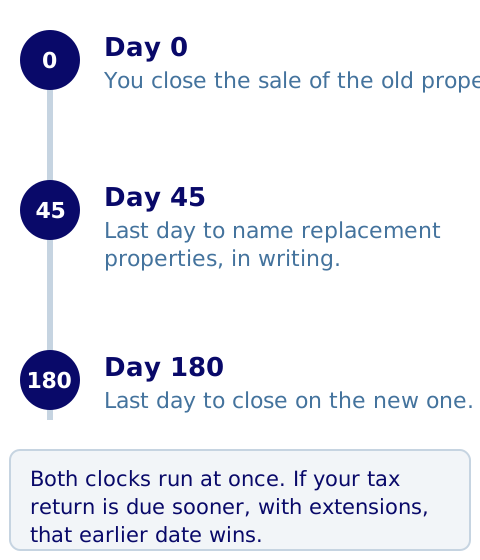
The dates come straight from the statute (IRC section 1031(a)(3)), and it has no grace period. Miss either one and the replacement property stops counting as like-kind. That usually makes the whole sale taxable.
Why can't you touch the money?
If the sale proceeds ever land in your own account, the exchange fails. A qualified intermediary holds the money between the sale and the purchase, so you never have it. Hire one before you close the sale, not after.
The rules on receiving the money, and the safe harbor that lets an intermediary hold it, are in Treasury Regulation 1.1031(k)-1.
What is boot, and how do you avoid it?
Boot is cash or other value you take out of the exchange. It is taxable in the year of the exchange. If you also receive other, non-like-kind property or money, you recognize gain to that extent (IRS Form 8824 instructions).
Two things create boot. Cash you pocket is one. Debt you are relieved of and do not replace is the other. To defer all the gain, you generally buy replacement property that is equal or greater in value, take on equal or greater debt, or add cash.
How does depreciation recapture work in an exchange?
The depreciation you claimed over the years is taxed when you sell. Part of it is taxed at a higher rate than regular capital gain: up to 25 percent, against 15 or 20 percent for most long-term gain (IRS Topic 409). A 1031 exchange can defer that too.
Be careful with anything that speeds up depreciation, like a cost segregation study. Faster depreciation means more recapture to defer. Plan the two together, and read how a lazy 1031 works and when it backfires.
Heirs get a new tax basis at death in many cases (IRC section 1014), which can erase deferred gain. That is a planning conversation of its own.
What mistakes cost investors the most?
| Mistake | What happens | Where to read the rule |
|---|---|---|
| Missing the 45 or 180 day deadline | The replacement stops qualifying, and the sale is usually taxable | IRC section 1031(a)(3) |
| Letting the proceeds touch your account | The exchange fails | Treasury Regulation 1.1031(k)-1 |
| Buying less than you sold | Taxable boot | Form 8824 instructions |
| Trading with a related party | A two-year holding rule applies | IRC section 1031(f) |
| Treating a vacation home or former residence as a clean investment property | The IRS may challenge it. A safe harbor exists for dwelling units that meet its tests. | Revenue Procedure 2008-16 |
| Waiting until you have a buyer to plan | Options shrink once the sale closes | Plan before you list |
When does a 1031 exchange not fit?
| Option | What it does | Worth knowing |
|---|---|---|
| Lazy 1031 | You skip the formal exchange, buy another rental, and offset the gain with depreciation | No deadlines, and risks of its own. Read how it works. |
| Installment sale | You are paid over time and report the gain as you receive payments | IRC section 453, IRS Publication 537 |
| Delaware statutory trust (DST) | An investment that can serve as replacement property for people who do not want to manage a building | The IRS addressed it in Revenue Ruling 2004-86. It is an investment, so it is a conversation for a licensed investment advisor. |
| Pay the tax and move on | You owe the tax now | Sometimes the right answer, once you see the real numbers |
What does Anvil do for a 1031 exchange?
Anvil gives tax advice, not investment advice. We work out your gain, your basis and your recapture before you list the property, so you know what an exchange is worth to you and whether another option is better.
We work alongside your CPA, your attorney and your qualified intermediary.
Not sure whether you need a CPA or an enrolled agent? Read the difference. Selling a whole business, not one building? Start with selling a business.
What should you ask your advisors?
- What is my gain, my adjusted basis and my depreciation recapture?
- How much tax am I deferring, and what happens when I sell the new property?
- Do I have a qualified intermediary lined up before closing?
- Is there any boot, and could I avoid it?
- What is my plan if I cannot find a replacement property within 45 days?
Where can you check these rules yourself?
- The exchange rules: IRC section 1031, Treasury Regulation 1.1031(k)-1, the IRS like-kind exchange tips, and the Form 8824 instructions.
- Dwelling units: Revenue Procedure 2008-16.
- Delaware statutory trusts: Revenue Ruling 2004-86.
- Capital gain and recapture rates: IRS Topic 409 and IRS Publication 544.
- Installment sales: IRC section 453 and IRS Publication 537.
- Basis at death: IRC section 1014.
This page is general information, not tax, legal or investment advice for your situation. Reading it does not create a client relationship. Tax law changes often, so check the current rules with a qualified professional before you act. See our disclaimer.