
Does Washington tax the sale of my business?
It can. Washington's capital gains tax skips real estate and equipment and lands on goodwill, and a family-owned business may deduct the gain if its clocks were never broken.
Does Washington tax the sale of my business?
Whether your sale is taxed, and how much, comes down to what you sell, how the price is allocated, and whether you qualify for the family-owned small business deduction. Most of that is decided before the buyer ever shows up.
How much is the Washington capital gains tax on a business sale?
The base rate is seven percent of Washington long-term capital gains after a standard deduction. The deduction started at 250,000 dollars and is indexed each year (RCW 82.87.060). A married couple shares one deduction, not two.
| Tax year | Standard deduction | Family business revenue cap |
|---|---|---|
| 2024 | 270,000 dollars | 10,790,000 dollars |
| 2025 | 278,000 dollars | 11,095,000 dollars |
Those are the Department of Revenue's published figures (Washington Department of Revenue). The Department must publish each new year's amounts by October 31 (RCW 82.87.150). Its table did not yet show 2026 when this page was written, so check it for the year you close.
Gain above 1,000,000 dollars pays the extra 2.9 percent, so the top combined rate on a large sale is 9.9 percent (Washington Department of Revenue, tiered rates).
When is the Washington tax due?
The return is due with your federal return, and an extension to file does not extend the time to pay (RCW 82.87.110). If you close in June and extend your federal return, the Washington money is still due the following April 15.
Filing late adds a penalty of five percent a month, up to 25 percent. For tax year 2026, the Department accepts prepayment up to six months before the due date (Washington Department of Revenue, capital gains tax).
Is Washington adding an income tax?
It passed one. SB 6346, signed in 2026, taxes Washington taxable income at 9.9 percent above a 1,000,000 dollar standard deduction, starting with tax year 2028 (SB 6346 as passed).
The same law gives a nonrefundable credit for Washington capital gains tax paid in the same year. Voters decide on Initiative 645, which would repeal the new tax, on November 3, 2026 (Ballotpedia). A sale planned for 2028 or later needs a fresh look once the result is in.
Which parts of my business are exempt from the tax?
More than most owners expect (RCW 82.87.050):
- Real estate transferred by deed or real estate contract.
- The part of the gain on a privately held entity that comes from real estate the entity owns. The statute uses a formula: the real estate's fair market value minus its basis, times the share of the entity you sell.
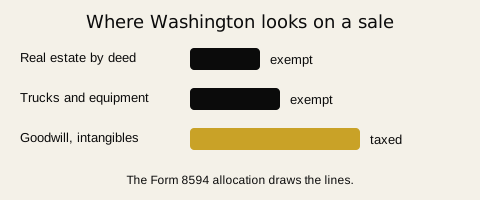
- Property depreciable under section 167 or expensed under section 179, which covers trucks, equipment and furniture.
- Retirement accounts, plus a few narrow items like timber, livestock and commercial fishing privileges.
What is left is mostly goodwill, customer lists, non-competes and the value of an entity interest beyond its real estate. For a service or contracting business, that is usually the biggest number on the closing statement. Whether section 197 intangibles count as depreciable property here is a question for your CPA (26 USC 197).
How does the Form 8594 allocation decide what Washington taxes?
In an asset sale, you and the buyer split the price across asset classes and both report it on Form 8594 (IRS Form 8594 instructions). A written allocation binds you both (26 USC 1060).
That same split becomes the map for Washington. Dollars on equipment fall under the depreciable property exemption, and dollars on a building transferred by deed fall under the real estate exemption. Dollars on goodwill stay in the Washington base.
The buyer usually wants more on equipment for faster write-offs. You usually want more on goodwill for federal capital gain treatment. Washington adds a third pull on that rope, so know which way you are pulling before the letter of intent is signed.
Can the family-owned small business deduction wipe out the tax?
It can, if you fit (RCW 82.87.070):
- You sell substantially all of the business, at least 90 percent of its assets or of your interest.
- Worldwide gross revenue was 10,000,000 dollars or less, indexed, in the twelve months before the sale.
- You held a qualifying interest for at least five years right before the sale.
- You or your family materially participated in at least five of the ten years before the sale. A sale to a qualified heir, who is a family member, waives this test.
Read that revenue cap carefully. A business that grows past it in the year before closing walks away from the deduction.
Why do the five-year clocks start before exit planning starts?
Both tests look backward from the sale date. Bring in a partner, move interests into a trust, or step back from operations in the two years before a sale, and you may reset or break a clock without knowing it.
The statute says a change in entity type alone does not restart the holding period. It says nothing about a gift of shares to a child who never worked in the business. Planning that starts two or three years out is often too late to fix a clock problem, and exactly the right time to spot one.
Will I owe B and O or sales tax on the sale itself?
Usually not B and O. A sale of assets you do not regularly sell is a casual or isolated sale, and B and O tax does not apply to it (WAC 458-20-106).
Retail sales tax is a different matter. Machinery, vehicles and furniture are retail sales, and the buyer owes sales tax on them unless an exemption applies. Inventory sold to a buyer with a reseller permit falls under wholesaling B and O. Goodwill and other intangibles are not typically subject to either tax (Washington Department of Revenue, selling your business).
So the equipment line needs a second look. It lowers your capital gains base and raises the buyer's sales tax bill.
What does this look like in a real deal?
Picture Vince, a composite with details changed: a commercial roofing company in Spokane doing about 6,200,000 dollars a year, plus four rental houses on the side.
A competitor offered 4,200,000 dollars for the company. Early drafts put 600,000 dollars on trucks and equipment, 200,000 dollars on inventory, and the rest on goodwill and a non-compete.
The rentals stayed out of the deal, and real estate by deed is exempt anyway. Vince had owned and run the company for 25 years and sat under the revenue cap, so the family business deduction looked clean.
The problem was a gift. Eighteen months earlier, Vince had given 30 percent of the company to the son who runs projects, as a reward and a succession step. The holding test is taken by each owner who claims the deduction, and the statute does not say a gift carries the giver's years over.
Vince's share of the gain qualified. The son's share likely did not, and that tax came out of the same family. This could have been avoided. The fix was a calendar, and a talk about whether the gift could wait until after closing.
What should I do before I sign?
- Pull your trailing twelve-month revenue and compare it to the indexed cap for the year you expect to close.
- Confirm who has held what interest since when, and who materially participated in which years.
- Get the draft Form 8594 allocation before the purchase agreement is final, and model the Washington base from it, not from the headline price.
- Decide whether the buyer's sales tax on equipment is handled by exemption, by price, or by surprise.
- Put the following April 15 on your calendar with a payment reserve, or prepay.
If the business sits in Oregon or you live there, see Oregon tax on the sale of a business. Selling a business covers structure and timing.
How is this different from what a CPA does?
A CPA's job in a sale year is usually to report the deal correctly once the terms are set and the year is over. That work is necessary, and it is not this. The Washington tax is decided by holding periods, participation history, revenue timing and the allocation, all settled before anything is reported.
Daveed spent nearly seven years inside the IRS looking at returns after the fact. This work looks at the deal before the fact, so there is nothing to argue about later.
What is the next step?
Would it be a bad idea to know your Washington number before the letter of intent? Take the Stop the Tax Leaks Scorecard. If an offer is real, book a Right Fit Call, and bring the draft allocation.
Anvil is not a CPA firm and not a law firm. This is general information, not tax advice. Talk to a qualified professional about your situation.
Where can you check these rules yourself?
- RCW 82.87.040, capital gains tax rates
- RCW 82.87.050, exemptions
- RCW 82.87.060, standard deduction
- RCW 82.87.070, family-owned small business deduction
- RCW 82.87.110, returns, payment and penalties
- Washington Department of Revenue, do you owe capital gains tax
- WAC 458-20-106, casual or isolated sales
- IRS Form 8594 instructions
The stories on this page are composites. They are inspired by real situations, but names, facts and details have been changed.
This page is general information, not tax, legal or investment advice for your situation. Reading it does not create a client relationship. Tax law changes often, so check the current rules with a qualified professional before you act. See our disclaimer.