
Selling something big? Here is what it is worth after taxes
The number on the offer is not the number you keep. Four tax layers sit between them, and the only way to know what is left is to run the sale through all four before you sign.
What are you selling?
Pick the page for the thing you are selling. Each one is its own page because the rules differ, the forms differ, and the people who sell bad advice differ. A business sale and a rental sale can land in the same year and still be taxed as two separate events, which is where most of the surprises start.
| What you are selling | Start here | The question most people ask first |
|---|---|---|
| A business | Selling a business or, if an offer just arrived, the letter of intent page | What should I know before I sign? |
| A rental or investment property | 1031 exchange and the lazy 1031 | Can I keep the money working instead of paying the tax now? |
| Stock that has gone up a lot | Page in progress | How do I avoid some of the capital gains tax on stock? |
| Crypto | Page in progress | Does the IRS already know I sold? |
| Something you inherited | Page in progress | Do I pay tax on an inherited house, account or IRA? |
Selling a business already? Form 8594: who files it shows how the split of the price sets the tax, and Does selling a business trigger an IRS audit? shows what an examiner reads after the sale.
Why does the tax on a big sale surprise so many people?
It sounds like you were told the gain is "just capital gains." That phrase hides four separate bills: the gain itself, the depreciation you already deducted coming back as income, a 3.8 percent net investment income tax above a threshold, and Oregon, which taxes a gain like wages, plus two more taxes inside Portland.
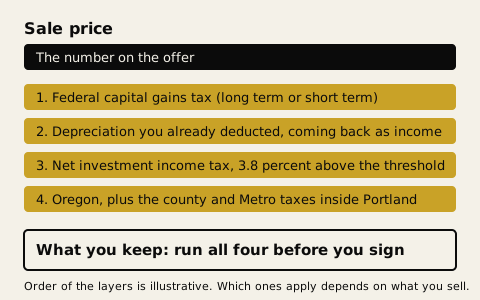
The gain is long term, and gets the lower federal rates, only if you held the asset more than one year (IRS Topic 409). The 3.8 percent net investment income tax starts at 200,000 dollars of income for a single filer and 250,000 dollars for a married couple filing jointly, and those thresholds do not rise with inflation (IRC section 1411). Oregon's top rate is 9.9 percent (Oregon Department of Revenue rate charts). Inside Portland, the Preschool for All tax adds 1.5 percent above 125,000 dollars for a single filer and three percent in total above 250,000 dollars, and the Metro housing tax adds one percent above 128,000 dollars for 2026 (Multnomah County, Portland Revenue Division).
The villain here is not the IRS and it is not your accountant. The villain is not knowing. The cure is cheap: you run the numbers before the signature, not after.
What should you do before you sign?
Five things, in this order. Each one changes the number you keep, and none of them can be done after closing.
- Find your basis. What you paid, plus what you put in, minus depreciation you took. If you cannot find it, that is the first job, not the last.
- Model the sale with every layer: federal, the 3.8 percent, Oregon, and the Portland taxes if they apply, in the year the money lands.
- Read the structure, not just the price. Asset sale or stock sale, lump sum or payments over time, how the price is split, any non-compete.
- Decide what the money is for. Reinvesting it, giving part of it, or spreading it across years each change the bill.
- Bring the team together. CPA or EA, attorney, broker or agent, advisor. Each one knows a piece. Someone has to hold the whole picture.
What did I see from the other side of the table?
For six years I was the IRS auditor across the desk. People could have saved an extra 15,000 or 30,000 or 150,000 dollars each year, and their accountant, CPA or attorney was sitting right there and didn't say a thing. I remember thinking: this has to stop.
That is why this site exists. Tax prep documents your past. Tax planning designs your future.
On a big sale the gap is wider, because the choices that move the number are made before the signature. On Everest, most of the people who die are on the way down. A sale works the same way: the danger is after you think you have made it.
How is this different from what my accountant does?
Most accountants are trained to report what happened. This page is about the year before it happens, while the choices are still open.
That is what the former auditor view means on this site. I know what the government looks at, so you can look at it first.
Selling a rental? Who checks the numbers on my rental shows what the buyer's lender and an examiner read.
Anvil is not a CPA firm and not a law firm. Daveed Tuck is a former IRS auditor and an Enrolled Agent, and our work is to find out where the tax will land before it does.
What is the next step?
Would it be a bad idea to find out where the leaks are before you sign? Take the Stop the Tax Leaks Scorecard. If the sale is real and you want a second set of eyes on the deal itself, book a Right Fit Call.
If the timing is wrong, tell me no. The pages above are yours either way.
Where can you check these rules yourself?
- IRS Topic 409, capital gains and losses
- IRC section 1411, the net investment income tax
- IRS questions and answers on the net investment income tax
- Oregon Department of Revenue tax rate charts
- Multnomah County Preschool for All personal income tax
- City of Portland Revenue Division, personal taxes
The stories on this page are composites. They are inspired by real situations, but names, facts and details have been changed.
This page is general information, not tax, legal or investment advice for your situation. Reading it does not create a client relationship. Tax law changes often, so check the current rules with a qualified professional before you act. See our disclaimer.