
Form 8594: who files it, and what if the buyer and I disagree?
The sale price is the headline. The allocation is the tax bill, and a split you never read can cost you real money. Form 8594 is where that allocation lands, and by the time anyone fills it out, the split was usually decided by someone else.
What is Form 8594?
Form 8594, the Asset Acquisition Statement, reports how the price of a business sold as a group of assets is split across seven asset classes. The buyer and the seller each attach it to their income tax return for the year of the sale. That split decides how much of your gain is taxed as ordinary income.
It sounds like you are worried the number on the offer is not the number you keep. That worry is fair. The gap between the two lives on this one page.
Who has to file Form 8594?
Generally, both of you. If you sell the assets of a business and goodwill or going concern value attaches, or could attach, to them, you file and so does the buyer (Form 8594 instructions).
The law calls this an applicable asset acquisition: the buyer's basis comes wholly from what it paid (IRC section 1060).
| Situation | Does Form 8594 apply? | Where to read |
|---|---|---|
| You sell the assets of your business | Yes, the seller and the buyer each file | Form 8594 instructions |
| Part of the deal is a section 1031 like-kind exchange | Not for the like-kind part. The rest of the deal still goes on the form | Form 8594 instructions |
| You sell a partnership interest | Generally no, unless the purchase is treated as buying the partnership's business assets (Rev. Rul. 99-6) | Form 8594 instructions |
| You sell the stock of a corporation | No. A plain stock sale is not an asset sale | Does selling a business trigger an IRS audit? |
Whether your deal is an asset sale at all is the first question to settle. The selling a business page covers assets versus stock.
When is Form 8594 filed?
Attach it to your income tax return for the year the sale happened. If the amount allocated to an asset goes up or down in a later year, the side affected files a supplemental Form 8594 (Parts I and III) with the return for the year the change is taken into account, and gives the reason.
If a correct form is not filed by the due date and there is no reasonable cause, penalties under sections 6721 through 6724 can apply. The dollar amounts are indexed and change, so check the current figure before you rely on one.
What are the seven asset classes?
Seven buckets, filled in order. Cash comes first and goodwill comes last. Where your trucks and equipment land is where most of the tax surprise lives, because Class V is where depreciation you already took comes back as income.
| Class | What goes in it | Why it matters to the seller |
|---|---|---|
| Class I | Cash and deposit accounts | Comes off the top first |
| Class II | Actively traded property, certificates of deposit, foreign currency | Filled at fair market value |
| Class III | Accounts receivable and other debt instruments | Filled at fair market value |
| Class IV | Inventory | Inventory cannot be reported on the installment method (Publication 537) |
| Class V | Everything not in another class: furniture, fixtures, buildings, land, vehicles, equipment | Gain up to the depreciation you took is ordinary income (IRC section 1245) |
| Class VI | Section 197 intangibles other than goodwill, such as a non-compete or a customer list | The buyer writes these off over 15 years (IRC section 197) |
| Class VII | Goodwill and going concern value | Gets whatever is left after Classes I to VI |
If an asset could fit two classes, it goes in the lower numbered one.
How does the residual method decide where the money goes?
The price fills the classes in order. Class I comes off first. What remains fills Classes II through VI, each only up to the fair market value of the assets in it. Whatever is left over lands in Class VII, goodwill and going concern value (Form 8594 instructions).
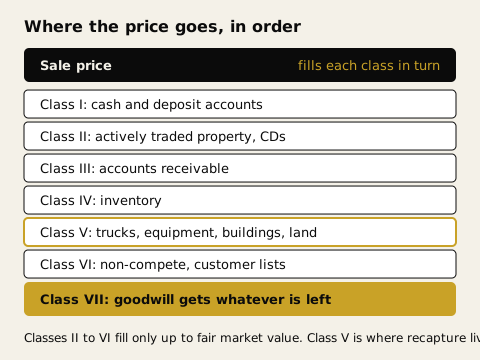
- Start with the total price.
- Take Class I off first.
- Fill Classes II, III, IV, V and VI in that order, each up to fair market value.
- Put the remainder in Class VII.
Goodwill is a leftover. So a round number sitting in Class VII is a guess, not a result. The real work is the fair market value of everything above it, starting with your equipment list and its depreciation history.
What if the buyer and I disagree on the allocation?
Disagree before you sign. If you and the buyer agree in writing on the allocation, that agreement binds both of you unless the IRS determines it is not appropriate (IRC section 1060, Publication 537). You are held to it, so read it before you sign.
The two sides usually want opposite things. The buyer wants more price on equipment, because it can be written off faster than goodwill, which a buyer amortizes over 15 years. For you, more price on fully depreciated equipment means more ordinary income. Same deal, same dollars, opposite tax results.
Courts hold people to what they signed. In Peco Foods, a buyer that later tried to reallocate for faster depreciation was held to its own allocation schedule (Eleventh Circuit, No. 12-12169, July 2, 2013, unpublished). In Muskat, a seller who said after the fact that part of the price was personal goodwill lost, because it never came up in the negotiations (First Circuit, No. 08-1513, 2009).
So the time to argue about the split is before the letter of intent hardens into a purchase agreement. If the buyer will not put an allocation in writing, ask why before you sign anything.
What does the equipment line cost you?
Equipment and vehicles sit in Class V. Gain on them up to the depreciation you already took is ordinary income, not capital gain (IRC section 1245).
That recapture is reported in the year of the sale, even when part of your price arrives in later years (Publication 537).
A composite story: Nora and the allocation she never read
Nora is 62 and owns an HVAC company her family built over thirty years. A regional buyer offered a number that made her cry in the parking lot, in a good way. She signed the letter of intent that week.
What she did not read closely was the allocation schedule. The buyer's lawyers had put a large slice of the price on the trucks and equipment, and another slice on her five-year non-compete. Goodwill, the part she thought she was selling, got what was left.
The trucks were mostly depreciated, so the recapture landed in year one, even though a third of her price was coming over three years. In April she owed tax on money that had not arrived. Once both sides signed the written allocation, it bound them both.
Nothing about the sale was illegal or unusual. The split was decided by the other side, and nobody on her side asked how the price was being divided.
This could have been avoided.
What if the price changes after closing?
An earnout or a purchase price adjustment changes the amount allocated to the assets, so the side affected files a supplemental Form 8594 for each year a change is taken into account.
An increase is allocated starting with Class I. A decrease comes off Class VII first, then Classes VI, V, IV, III and II (Form 8594 instructions).
If your deal has an earnout, put the supplemental filing on the calendar for every year a payment can arrive.
Do the buyer's and the seller's forms have to match?
The Form 8594 instructions do not say the two forms must match, and their totals often differ. A signed written allocation binds both sides to one split, so the class by class picture should tell the same story. Does selling a business trigger an IRS audit? covers what draws questions after the sale.
What should you do before you sign?
Five steps, in this order. Every one of them is cheap before the signature and expensive after it.
- Pull your fixed asset list and the depreciation taken on each item, so you know what recapture each equipment figure creates.
- Ask the buyer for a class by class allocation schedule early, at or before the letter of intent.
- Model what each proposed split leaves you after tax, the same way you model the price.
- Decide whether a non-compete is paid to you or to the company, and make sure the number has a basis behind it.
- Make the signed allocation an exhibit to the purchase agreement, with a promise from both sides to file consistently with it.
Where does this fit in a bigger sale?
Form 8594 is one piece of selling a business, which sits under selling something big, our page on what any big sale is worth after taxes. If an offer just arrived, start with what to know before you sign a letter of intent.
What is the next step?
Would it be a bad idea to find out where the leaks are before the buyer's side sets your split? Take the Stop the Tax Leaks Scorecard first. If a sale is on the table, book a Right Fit Call before the letter of intent.
If the timing is wrong, tell me no. This page is yours either way.
Anvil is not a CPA firm and not a law firm. Daveed Tuck is an Enrolled Agent, an Oregon Licensed Tax Consultant, and a former IRS auditor, and the work is to find out where the tax will land before it does.
Where can you check these rules yourself?
- Instructions for Form 8594, Asset Acquisition Statement (Rev. November 2021)
- IRC section 1060, allocation in an asset acquisition, including the written agreement rule
- IRS Publication 537, Installment Sales, including Sale of a Business and recapture in the year of sale
- IRC section 1245, depreciation recapture on equipment
- IRC section 197, the 15 year write-off for goodwill, a non-compete and other intangibles
- Peco Foods v. Commissioner, Eleventh Circuit, 2013
- Muskat v. United States, First Circuit, 2009
This is general education, not advice for your sale. Talk to a qualified professional before you act.
The stories on this page are composites. They are inspired by real situations, but names, facts and details have been changed.
This page is general information, not tax, legal or investment advice for your situation. Reading it does not create a client relationship. Tax law changes often, so check the current rules with a qualified professional before you act. See our disclaimer.