
Does selling a business trigger an IRS audit?
The sale itself is not the trigger. The cost comes later, when the return you file is the first thing read against the deal papers and the numbers do not line up, with the buyer holding the other half of the story.
Does selling a business trigger an IRS audit?
No. The IRS does not publish a rule that selling a business triggers an exam.
What changes is your return. It carries a large gain and a Form 8594, and the buyer files the same deal from the other side. Mismatches are what invite questions.
That is the honest answer, and it is also the useful one. You cannot control whether a return is picked. You can control whether the return, the books, the bank statements, and the purchase agreement tell the same story.
Why can a sale year still draw attention?
Three things change at once.
- The return gets bigger. One year carries a gain that dwarfs the years around it.
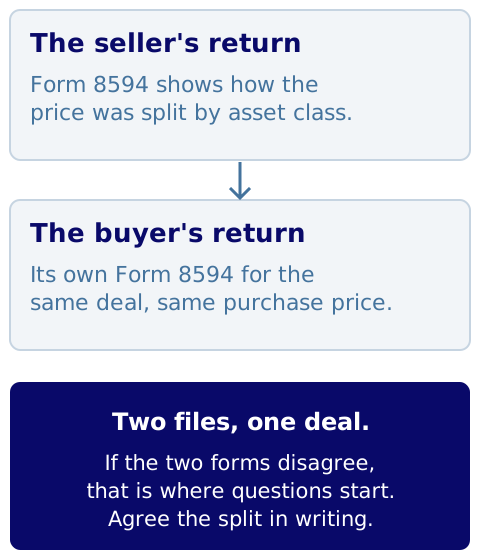
- Two taxpayers report one deal. You file a price split. The buyer files a price split for the same purchase.
- The numbers stop being private. A buyer's accountant has already read your books, your bank statements, and your tax returns before the closing.
None of that is a flag by itself. Together it means your numbers have already been read by someone whose job was to find the weak spots. Examiners ask many of the same questions, which is why it pays to ask them first.
What do the seller and the buyer each file?
Both of you file Form 8594 with the return for the year of the sale. It lists how the price was split across seven asset classes. If you and the buyer agreed to the split in writing, the law binds both of you to it unless the IRS finds it inappropriate.
That applies to asset sales and deals taxed like them. A plain stock sale does not use Form 8594, and a stock deal treated as an asset sale uses a sister form, Form 8883. For how the split itself works, see what Form 8594 is and how the seven classes fill.
| Who | What they file | What it shows | Where to read |
|---|---|---|---|
| The seller | Form 8594, attached to the return for the year of the sale | How the price was split across asset classes, which sets your gain and how much is ordinary income | Form 8594 instructions |
| The buyer | Form 8594, attached to the buyer's return for the same year | The same split, which sets the buyer's basis | Form 8594 instructions |
| Both, if the split changes later | A supplemental Form 8594 for the year of the change | The reason for the change and the earlier filing | Form 8594 instructions |
| Both, if the form is wrong or late | Penalties under sections 6721 through 6724, unless there is reasonable cause | Whether the form was filed correctly and on time | Form 8594 instructions |
The rule that binds you to a written split sits in IRC section 1060. Real estate in the deal may qualify for a 1031 exchange, which adds its own paperwork on top.
Do the buyer's and the seller's Form 8594 have to match?
The Form 8594 instructions do not say the two forms must match. The written purchase agreement binds both sides to one split, so the two forms should agree. The IRS itself lists buyer versus seller as a typical whipsaw issue, where one deal produces conflicting claims from two taxpayers.
The IRS defines a whipsaw as a situation where the government is "subjected to conflicting claims by taxpayers" (IRM 4.10.7). The same list names goodwill versus a covenant not to compete. Both are decided in the purchase agreement, long before anyone files anything.
No IRS publication we have found says examiners compare the two forms side by side. Plan as if someone might, because agreeing the split in writing costs you nothing.
What does an examiner actually do with a business return?
Examiners must run minimum income probes on every return they open. The manual calls for a bank analysis of personal and business accounts and a test that ties gross receipts to source documents. Heavy mixing of personal and business money is listed as a sign of weak controls.
In plain English, the examiner asks whether the money that went into your accounts matches the income on your return, and whether your books can prove it. The manual says the probes are "designed as a set of analytical tests intended to determine whether the taxpayer accurately reported income" (IRM 4.10.4.2).
A buyer's accountant asks close to the same thing. The vocabulary changes. The test does not.
What would that look like in a made-up example?
Picture an owner whose company paid for a family car, a few home repairs, and a relative on payroll for years. Those deductions sat on three returns without a problem.
Then a buyer's accountant lists them as personal items to strip out of earnings. The same list is what an examiner tests with a bank analysis. Same facts, two readers.
The fix is the same for both: know what is in your books before someone else tells you.
What happens when the bank deposits do not match the return?
Auditors start with your bank and investment statements. They total the deposits and compare the total to the gross income on your return. Deposits you cannot explain become questions, so write the source on every deposit, especially transfers between your own accounts.
Here is a case from my files, with details changed. A business owner left about 97,000 dollars of income off a return. Preparing for the audit took roughly 90 hours. With penalties and interest, around 23,000 dollars was at stake, and a fraud referral was on the table.
Another owner bragged at a networking event that he had caught up a full year of bookkeeping in two weeks at year end. That return was audited.
I spent six years as an IRS auditor, and most of the adjustments I saw traced back to poor records. Rebuilding records after the fact costs more time and money than keeping them in the first place. A sale makes it worse, because a buyer is about to read the same records you have been avoiding.
This could have been avoided. Keep the records while the sale is still ahead of you.
How long can the IRS look back after the sale?
Generally three years from the date you filed the return. It stretches to six years if you leave out more than 25 percent of the gross income shown on the return. There is no limit if you never file or the return is fraudulent. The sale year starts its own clock.
All three rules are in IRC section 6501. The long periods are the exceptions. The ordinary case is three years, and the sale-year return is the one with the most in it.
What should you clean up before you sell?
Do these while there is still time to fix what you find. Cleanup takes months, not days.
- Tie the bank deposits for the last three years to the gross receipts on your returns. Write down the reason for every gap.
- Stop paying family costs through the business. Separate personal spending from business spending going forward.
- Reconcile your books to each return, so the return can be rebuilt from the ledger.
- List every personal or one-time item that ran through the business, and keep proof of what each one was.
- Put the price split in the purchase agreement, and agree it with the buyer before the deal hardens.
- Keep the signed purchase agreement, the closing statement, and a copy of the filed Form 8594 in one place.
- Have someone read the sale-year return against the deal papers before it is filed.
Step seven is the one most owners skip, and it is the one an examiner would do first.
How does Anvil help with this?
Anvil is not a CPA firm. Daveed Tuck is an Enrolled Agent, an Oregon Licensed Tax Consultant, and a former IRS auditor. The work is to read your returns and your books the way an examiner would, before the deal, and work alongside your CPA and your attorney instead of replacing them.
If you are planning a sale, start with the selling a business page, which covers structure, price split, and timing. Would it be a bad idea to run the numbers with us before you sign? Start with the Stop the Tax Leaks Scorecard. If the timing fits, book a Right Fit Call.
Where can you check these rules yourself?
- IRC section 6501, limits on assessing tax
- IRC section 1060, allocation rules for asset acquisitions
- Form 8594 instructions, asset acquisition statement
- IRM 4.10.4, examination of returns, income probes and bank analysis
- IRM 4.10.7, issues, including whipsaw
Rules and forms change. Read the source before you rely on a detail, and check how your state treats the sale.
The stories on this page are composites. They are inspired by real situations, but names, facts and details have been changed.
This page is general information, not tax, legal or investment advice for your situation. Reading it does not create a client relationship. Tax law changes often, so check the current rules with a qualified professional before you act. See our disclaimer.