
I just got a letter of intent for my business. What should I know before I sign?
Most of a letter of intent is not binding, two or three clauses in it are, and the parts that set your tax bill are already in there, written by the buyer's side.
Is a letter of intent binding?
Usually not, as to price and terms. A typical letter of intent says the deal terms are not binding and that only the final purchase agreement will bind anyone. The clauses that usually do bind: confidentiality, exclusivity (the no-shop period), who pays which expenses, and sometimes a duty to negotiate in good faith.
If the letter does not say which parts bind, do not guess. Ask an attorney. I am not one, and this page is not legal advice; my job is the tax side.
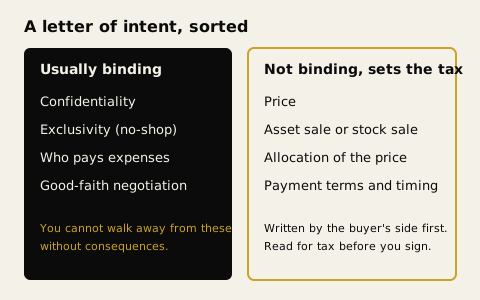
Practitioner guides say the same thing in lawyer language: a letter of intent "is typically not legally binding between the parties" apart from confidentiality and similar matters, and a careless one can create binding commitments by accident (Baker McKenzie's global guide to private company deals, United States chapter). That last part is the one to remember.
Can you back out after signing a letter of intent?
From the non-binding terms, yes, and so can the buyer. From the binding clauses, no, not without consequences. The one that bites sellers is exclusivity. A 60 or 90 day no-shop window means your best alternative buyer is frozen out while this buyer does due diligence and, often, re-trades the price.
A shorter window, or one that ends if the buyer misses a milestone, is a seller-side ask. It is easier to get before you sign than after.
How serious is a letter of intent?
Serious enough to set the shape of the deal. Price, structure, what is included, the due diligence period, exclusivity, and often a proposed split of the price among the assets all show up first in the letter. Whatever is written here becomes the starting point for the purchase agreement.
Treat it as the first draft of your tax return for the year of sale, because it is.
What in the letter of intent sets your tax bill?
The sale price is the headline. The allocation is the tax bill. Three things decide it, and none of them is the price. The structure, the allocation and the payment terms decide how much of the gain is taxed as ordinary income, how much as capital gain, and which year it lands in.
The buyer's team has already modeled all three for their side. The question is whether anyone has modeled them for yours.
| Term in the letter | What it decides | Where to read more |
|---|---|---|
| Asset sale or stock sale | Who gets taxed on what, and why buyers push for assets while sellers push for stock | Selling a business |
| Allocation of the price | In an asset sale both sides report the same split to the IRS on Form 8594, and the split decides how much of your gain is ordinary income (equipment, inventory, a non-compete) and how much is capital gain (goodwill) | IRC section 1060, Form 8594 instructions |
| Payment terms and closing date | A lump sum in December, a seller note, an earnout and an installment sale each land in different years and different tax buckets. Depreciation recapture is taxed in the year of sale even when you are paid later | IRC section 453, IRS Publication 537 |
A composite story: the savings that were too risky
The details are changed. An owner had a real chance to cut the tax on his sale by a lot of money. His attorney looked at the plan and said it was too risky. He trusted the room and signed the deal the way it was written.
Nine months later he called. Could he get some of that back? No. It was too late.
I see this every tax season: people leaving too much money on the table, and by the time the return is being prepared it is too late to negotiate the agreement. The structure was set the day he signed. The return only reported it. This could have been avoided.
Who should you talk to first?
In this order, and tonight if you can. First, the person who will read it for tax before anything is negotiated, an Enrolled Agent or CPA who does sale planning and not only returns. Then an attorney who handles business sales, for the binding clauses. Then your broker, to carry the asks back.
It sounds like you may be worried that bringing in advisors signals doubt. Buyers expect it. The sellers who worry them are the ones who sign fast.
Not sure which kind of tax professional fits? CPA or Enrolled Agent explains the difference in plain words.
How long does a letter of intent last?
Most letters set their own clock: a response deadline, an exclusivity period, and an outside date for signing the purchase agreement. If the clock is missing, ask for one. A letter with no end date is a no-shop with no end date.
What is the next step?
Take the Stop the Tax Leaks Scorecard first; it shows where the leaks are. If the letter is real and the clock is running, book a Right Fit Call and bring the letter. If the timing is wrong, tell me no and keep the page.
For the bigger picture across a business, a rental, stock or an inheritance, start at Selling something big.
Where can you check these rules yourself?
- IRC section 1060, allocation of the price in an asset sale
- IRS instructions for Form 8594
- IRC section 453, installment sales
- IRS Publication 537, installment sales
- IRS, sale of a business
- Baker McKenzie, global guide to private company deals, United States chapter on preliminary documents
The stories on this page are composites. They are inspired by real situations, but names, facts and details have been changed.
This page is general information, not tax, legal or investment advice for your situation. Reading it does not create a client relationship. Tax law changes often, so check the current rules with a qualified professional before you act. See our disclaimer.