
Who checks the numbers on my rental before I sell it?
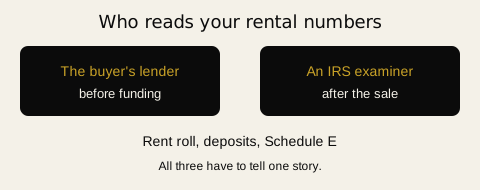
Two people, and neither one works for you. The buyer's lender reads your rent roll and your Schedule E before funding, and an IRS examiner can read the same numbers after the sale.
Who checks the numbers on my rental before I sell it?
What does the buyer's lender check on a rental?
For a conforming loan, the underwriter follows the Fannie Mae Selling Guide. It asks for the borrower's signed Form 1040 with its rental schedules, and in some situations the current lease and two months of bank statements showing rent paid (Fannie Mae Selling Guide, rental income).
Any difference between documented rent and the lease must be adequately explained by the borrower or the property manager. In plain terms, the lender reads your rent roll, reads your return, and asks why they disagree.
What does an IRS examiner check on Schedule E?
I spent nearly seven years as an IRS auditor. On the income side, the examiner ties the rent on the return to your records and your deposits. On the expense side, every large check gets sorted into repair or improvement.
A betterment, a restoration or an adaptation to a new use is an improvement that gets depreciated, not deducted (IRS tangible property regulations). The de minimis safe harbor covers items up to 2,500 dollars per invoice for a landlord without an applicable financial statement, and it is an annual election made on a timely filed return. A new roof written off as maintenance is the first thing they find.
Why do my Schedule E and my rent roll need to match?
Because the gaps are predictable. Advance rent is income when you receive it, a security deposit you keep is income the year you keep it, and a tenant paying your water bill or trading labor for rent is rental income (IRS Publication 527). Most rent rolls track none of that.
The Government Accountability Office estimated that at least 53 percent of individual taxpayers with rental real estate misreported it for tax year 2001, and called that an undercount (GAO-08-956). The settlement agent also reports your gross proceeds to the IRS on Form 1099-S, so your return has to match it or explain it (Form 1099-S instructions).
What comes back in the sale year?
| What comes back | How it is taxed | Where the rule lives |
|---|---|---|
| Depreciation on the building | Unrecaptured section 1250 gain, taxed at up to 25 percent | IRC section 1(h) |
| Cost segregation components, including bonus | Ordinary income under section 1245, recognized in the year of sale even on an installment sale | IRS Publication 537 |
| Suspended passive losses, the rental losses you could not use in earlier years | Released when you dispose of your entire interest to an unrelated party in a fully taxable sale | IRC section 469(g) |
| Net investment income tax | 3.8 percent above 200,000 dollars single or 250,000 dollars joint | IRS Topic 559 |
The depreciation that counts is what you were allowed or allowable, so depreciation you never claimed still reduces basis (IRS Publication 527). The 25 percent is a maximum rate, and a sale at a loss has none of it. Land was never depreciable, so if an early return depreciated the whole purchase price, the recapture number is already wrong.
Released passive losses first offset other passive income, and the rest becomes nonpassive. A sale to a related party keeps them suspended, and a gift does not release them. That is good news only if the losses were figured correctly.
Does a 1031 exchange change who checks?
It changes the timing, not the checker. An exchange applies to real property only. You have 45 days to identify a replacement and the earlier of 180 days or your return's due date to close (IRC section 1031).
A sale to a related party can undo the exchange within two years, and cash you take out is taxed, recapture first.
The qualified intermediary holds the money, not your Schedule E. The basis and the depreciation history carry into the replacement property, so a wrong schedule going in is wrong on the new property too. Our page on the 1031 exchange has the rest.
How long before listing should I clean this up?
Twelve months is comfortable. Six months is workable. Thirty days is triage.
Fixing a depreciation schedule means amending returns or filing Form 3115, depending on how many returns used the error, and Form 3115 brings a section 481(a) adjustment (Form 3115 instructions). You want that done before the buyer's lender asks for your latest return, not during escrow.
What does this look like in a real sale?
Picture Nora, a composite with details changed: a family HVAC owner in Reno with seven rentals on the side. Pat has kept the books for 14 years, and nobody has reviewed a close since Pat started.
When Nora decided to sell two rentals, the underwriter asked why Schedule E showed 94,000 dollars of rent and the rent roll showed 112,000 dollars.
Pat had been netting tenant-paid utilities and a kept deposit against repairs. A 22,000 dollar HVAC replacement had been expensed because the invoice looked like service. The land on two properties had been depreciated for years.
None of it was dishonest. It was a monthly close with no second set of eyes, about to be read by two strangers who get paid to find exactly this. This could have been avoided.
What should I do before I list?
- Lay the last three years of Schedule E next to the rent roll and the bank deposits for the same months, and write one line explaining every gap.
- Confirm the land was carved out on every property, and that every large check sits on the right side of the repair or improvement line.
- Run Form 8582 forward to see what suspended losses will release.
- If a cost segregation study exists, get the component list and estimate the section 1245 piece.
- If you plan to carry a note, model the year-of-sale recapture before you agree to terms.
Then decide whether to amend, whether to exchange, and whether the sale year is this year or next. Selling something big shows every tax layer on the sale.
What is the next step?
Would it be a bad idea to read your rental file the way the lender and the examiner will, before they do? Take the Stop the Tax Leaks Scorecard. If a sale is coming, book a Right Fit Call.
Anvil is not a CPA firm and not a law firm. This is general information, not tax advice. Talk to a qualified professional about your situation.
Where can you check these rules yourself?
- IRS Publication 527, residential rental property
- IRS tangible property regulations
- IRC section 469, limits on rental and other passive losses
- IRC section 1031, like-kind exchanges
- IRS Publication 537, installment sales
- Form 1099-S instructions
- Fannie Mae Selling Guide, rental income
The stories on this page are composites. They are inspired by real situations, but names, facts and details have been changed.
This page is general information, not tax, legal or investment advice for your situation. Reading it does not create a client relationship. Tax law changes often, so check the current rules with a qualified professional before you act. See our disclaimer.