
Oregon workers' comp: do you need it before you hire anyone?
Oregon requires most employers to carry workers' compensation. Whether you do depends on who you pay and how your business is set up, and the owner is treated differently from the help.
Do I need workers' compensation in Oregon?
Rick, our fictional Portland roofer, is about to put his first helper on the truck. He does not need to be an insurance expert. He needs three answers: does the helper need to be covered, does he need to be covered himself, and who does he call to be sure.
Does the owner of my S corporation need to be covered?
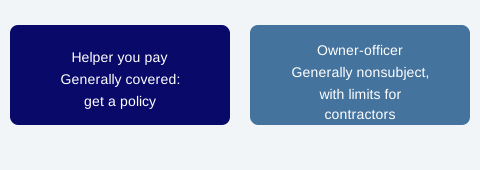
The statute is ORS 656.027. The paragraph on corporate officers says officers who are directors of the corporation and have a substantial ownership interest are nonsubject, regardless of the work they do. It then adds limits. One says that when labor or services are performed under contract, the corporation must qualify as an independent contractor to be a nonsubject worker.
For a roofer, the contractor rules matter. A separate paragraph covers corporations actively licensed under ORS 671.525 or 701.021, the state's contractor licenses.
If every officer belongs to the listed family relationships, they may elect to be nonsubject. Otherwise the number of exempt officers is capped at the greater of two, or one for every ten corporate employees. If Rick's corporation holds one of those licenses, that paragraph is the one to read first.
| Owner type | What ORS 656.027 says |
|---|---|
| Corporate officer | Nonsubject if a director with a substantial ownership interest, with limits |
| Contractor corporation | Special rules and a cap on exempt officers for licensed corporations |
| LLC member | Nonsubject, including members who are managers, with an independent contractor condition on contracted work |
| Sole proprietor | Nonsubject, with an independent contractor condition on contracted work |
Does my helper need to be covered?
Yes, in the normal case. The state says every worker in Oregon is a subject worker unless the worker falls under one of roughly 30 exceptions in Oregon law. A person you pay to work for you is generally a worker, so Rick's helper is covered by the requirement even if Rick himself is nonsubject.
How do I get workers' compensation coverage?
Most employers buy a policy through an insurance agent or directly from an insurer, or contract with a worker leasing company. If an insurer files proof of coverage for you, you do not file it yourself. If an insurer turns you down, you can apply to the Assigned Risk Plan, which NCCI administers.
Get the coverage in place before the helper starts work, not after the first day. The state pages I checked do not say when coverage must begin, so treat the first day on the job as the deadline.
Who do I call to be sure?
Call the Workers' Compensation Division. The division lists 888-877-5670 for employer compliance and 503-947-7815 for employer subjectivity, which is the question of who counts as a covered worker. Ask about your own corporation, your own license and your own officers.
Write down who you spoke to and the date. That note is part of your file.
What do I keep in the file?
- The insurance policy and the proof of coverage.
- A note on who is covered and who is nonsubject, with the statute you relied on.
- The date and name from your call to the division.
- A reminder to revisit it when the company hires its next person or adds an owner.
This could have been avoided with one phone call and a note in the file.
Where can you check these rules yourself?
- Oregon DCBS: Workers' compensation coverage
- Oregon Workers' Compensation Division: Employers
- Oregon Workers' Compensation Division: Contact us
- ORS chapter 656: Workers' compensation
The stories on this page are composites. They are inspired by real situations, but names, facts and details have been changed.
This page is general information, not tax, legal or investment advice for your situation. Reading it does not create a client relationship. Tax law changes often, so check the current rules with a qualified professional before you act. See our disclaimer.