
What to set up before you pay yourself or your first employee in Oregon
The forms are not hard. The order is what costs owners time, and a paycheck that goes out before the state account is open puts you behind from day one. Here are the six steps in sequence, with a page for each one.
What do you need before the first paycheck in Oregon?
You need a federal EIN, an Oregon business identification number (BIN), and a plan for Paid Leave Oregon, unemployment insurance, workers' comp and any transit tax. The BIN has to be in place before the first check, and registration can take weeks. Start early.
This applies the day you put yourself on payroll, not only the day you hire someone. An S corporation that pays its owner is an employer in Oregon's eyes. Corporations with no other staff still register to report what they pay their officers (Oregon Department of Revenue).
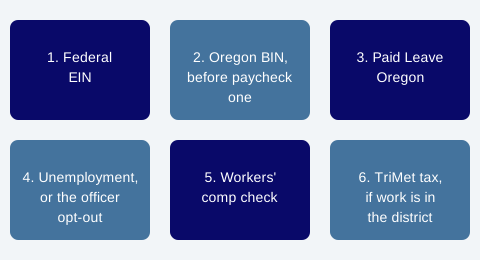
In what order should you set up Oregon payroll?
Start with the federal number, then the state account, then the payroll programs. Get the EIN after the state filing that forms your company. Register for the BIN before the first paycheck. Set up the rest before your first payroll run, because each one shows up on your quarterly payroll report.
| Step | What it is | Do you need it? | Read more |
|---|---|---|---|
| One | Federal EIN | Yes, to run a corporation or hire employees | How to get an EIN |
| Two | Oregon BIN | Yes, before the first paycheck | Oregon BIN |
| Three | Paid Leave Oregon | Yes, including a sole owner on payroll | Paid Leave Oregon |
| Four | Unemployment insurance | Yes, unless an eligible officer elects out | The officer opt-out |
| Five | Workers' comp | Depends on who works for you | Oregon workers' comp |
| Six | TriMet transit tax | Only for work inside the TriMet district | See below |
Can you skip any of these if you are the only employee?
Sometimes. A sole corporate officer and director with substantial ownership can elect out of Oregon unemployment insurance on Form 2578. The election is optional, so nothing happens unless you file it.
Workers' comp has its own rules for owners. The BIN is never optional for a corporation that pays its officer.
That unemployment choice is the one most owners never hear about. They pay the tax on their own paycheck for years. Nobody told them there was a form. This could have been avoided.
The officer opt-out page walks through who qualifies and the filing order. The workers' comp page covers which owners are exempt.
Does the TriMet transit tax apply to your payroll?
It applies when the work is performed inside the TriMet district. For 2026 and after, the rate is 0.8237 percent of gross taxable payroll for that work. The employer pays it. It is not withheld from employee pay, and you report it with your quarterly Oregon payroll filing.
Nonresident employers who pay wages for work in the district have to register and file too. Lane County has its own transit payroll tax. Both are covered in the Department of Revenue's guide to TriMet and Lane Transit payroll taxes.
Oregon's statewide transit tax is a different tax. It is withheld from employee pay, not paid by the business. As of October 2026, the Employment Department says to keep withholding it at 0.1 percent (Oregon payroll taxes).
How do the pages follow one owner through these steps?
Picture a fictional roofing contractor outside Portland who runs an LLC and says, "Show me the steps." Each page follows that owner through one of them.
On the BIN page, the roofer learns the registration has to happen weeks before the first check. On the Paid Leave page, the roofer hires a helper and sees what comes out of each paycheck. On the opt-out page, the roofer has elected S corporation status and learns that the LLC, not the election, decides whether the unemployment opt-out even applies.
Where can you check these rules yourself?
- IRS, Get an employer identification number
- Oregon Department of Revenue, Withholding and Payroll Tax
- Paid Leave Oregon, What employers need to do
- Oregon Employment Department, Corporate Officer Exclusion Request (Form 2578)
- Oregon Department of Revenue, TriMet and Lane Transit payroll taxes (150-211-503)
Would it be a bad idea to find out where your setup is leaking before the first paycheck? Start with the Stop the Tax Leaks Scorecard. If the timing fits, book a Right Fit Call.
The stories on this page are composites. They are inspired by real situations, but names, facts and details have been changed.
This page is general information, not tax, legal or investment advice for your situation. Reading it does not create a client relationship. Tax law changes often, so check the current rules with a qualified professional before you act. See our disclaimer.